
Treo 650 and Weight Watchers Software

A few years ago, I started on a weight loss program, inspired by an overheating incident while picking up trash for my company’s Adopt-A-Highway program. At that time, my PDA of choice was the Handspring Visor Deluxe, and I was able to track my calorie intake using a great program called DietLog. In about three months, I dropped nearly forty pounds before I hit a plateau. I still had ten or fifteen pounds to go to be in a truly healthy weight range, but I didn’t beat myself up over it, since I felt and looked much better.

My next PDA was a Handspring Treo 300, and I loaded DietLog’s evolution, BalanceLog, onto it. It worked fine, but didn’t do much to get me off my plateau. I still had to lose some weight to be close to the standards set by the National Institute of Health.

Recently, I upgraded to the new Treo 650 by Pa1mOne, a smartphone with a high-resolution screen, SD card slot, and built-in thumb keyboard. The device only (“only”?) has 32 Mb of memory, and I was aware of that going in, but I figured that wouldn’t be an issue for me since I was upgrading from a 16 Mb device. Of the 32 Mb on the Treo 650, about 23 Mb is actually usable by programs, so I figured I would still be ahead of the game when upgrading from 16 Mb.

I knew that the memory concerns about the new Treo were due to the fact that it has non-volatile flash memory (a good thing) and that it addresses that memory in a less efficient manner than its predecessor (a bad thing.) For example, the same contact information stored in my Treo 300 takes up nearly twice as much memory on my Treo 650 because of the way the memory must be addressed. Again, no big deal. I don’t have that many contacts or databases on my PDA, so I should have plenty of room.

Enter Weight Watchers. As a New Year’s Resolution, my girlfriend and I joined, hoping to get rid of the extra pounds. Being the geek that I am, I really did not relish the idea of carrying around a booklet to count my points, and thought it would be cool if Weight Watchers had a PDA application available. I checked the website, and after expressing some frustration that the their site refuses connections from Firefox, I reluctantly opened it in Internet Explorer. Sure enough, they have something called Weight Watchers On-the-Go that has all of the point values and tracking tools that I need. I signed up immediately.

The website said I needed to make sure I had enough memory on my device before installing. I had about 7 Mb free, which they said would be sufficient, though close to the minimum system requirement. I tried installing, and the installation went well except for one thing: the 27,000 record food database wouldn’t load. I tried clearing more space on the handheld, moving several applications to the SD card. When I had 12.7 Mb free, I tried again. Again, everything would load except for the food database.

At this point, I began to suspect that the Treo 650’s memory mishandling was causing a problem with all these database records. I sent an e-mail to the Weight Watchers tech support people, and three days later I got a response. In a nutshell, they said that I would not be able to install the WW On-the-Go program on the Treo 650 because they were experiencing “major incompatibilities” with the device, and were working with Pa1mOne to fix the problem. I wrote back and asked if those “major incompatibilities” had anything to do with inefficient memory storage for database records, but I haven’t gotten a response.

Here’s my guess: According to the Treonauts bloguide, database records take up 30% more space on the Treo 650 than on previous devices. In this case, I think that estimate is low. Considering that each record is stored in 512 byte chunks, even a database with small records like foods and their point values will take up half a kilobyte for each record. If Weight Watchers puts their entire database on the handheld, as they claim, the foods database alone would take up about 13.5 Mb on the Treo 650 (assuming 512 bytes per record and 27,000 records.)

That’s a huge waste of space, and doesn’t support Pa1mOne’s assessment that the only people who will be limited by the memory problem are power users. Sure, I consider myself to be a power user, but even if I weren’t, the foods database alone in the Weight Watchers program would gobble nearly 60% of the available memory on the handheld, not counting the code itself or any other programs the user might want to run. To me, a Weight Watchers member who just wants to use his or her PDA to track points does not constitute a power user.

This could have something to do with code bloat on the part of Weight Watchers (which would be a bit ironic), but I think the bigger problem lies in the lack of foresight by Pa1mOne. I read in one of the comments on the Treonauts site that the choice of processor for the Treo 650 and Tungsten T5 limits the non-volatile memory choices to either 32 Mb or 256 Mb. If that’s the case, it explains a lot. But if so, Pa1mOne should have elected to go with the 256 Mb option, rather than limiting users with a low memory overhead.
The Digital Generation Gap

I think technology is widening the generation gap at an increased rate. I guess technology has always been at the root of the gap, though when the term first surfaced in the sixties or seventies, I think it had more of an idealogical meaning. We’ve all heard stories about how kids today don’t know what an LP is, or how to use one. One of my favorite examples is from an early Bloom County strip, in which Binkley asks his father what it means “to wind one’s watch.” My kids have grown up in a post-MTV world, and they think in much more visual terms than I do when it comes to music, and sometimes even in terms of literature, thanks to movie adaptations of comic books and classic literature like Lord of the Rings.

Recently, I have seen a couple of new examples of technological generation gappage, both from my stepson, Logan.

One day, when picking him up from day care, he pointed up to a small Cessna flying overhead and asked if it was one of those “old-fashioned” planes. When I heard the term “old-fashioned,” I immediately thought about Steerman biplanes, and started to explain that the plane was not a biplane. “No,” he said, “I mean is it one of the kinds that just have one propeller that they have to use to fly.”

Then, last night, Lannette decided to take a picture of two of our cats, who were snuggling on the living room floor. She got out her compact 35mm, waited for the flash to activate, and took the picture. (Fortunately, the cats were content to sit and pose while the batteries warmed up the flash.) When she was done, Logan asked, “Can I see?”

“See what?” Lannette said, a confused look on her face.

“See how the picture turned out,” he replied. At that point, it dawned on both of us that Logan had grown up in an age where digital cameras are more common than 35mm cameras, and it was normal for him to expect to see immediate results on a small LCD screen.

As technology accelerates, this will, of course, become a wider gap. Ten years from now, when my son Keith has kids (if he has them that soon), my grandchildren will grow up in a world where PDAs will be a requirement for elementary students, and the teachers will automatically beam the homework assignments to the classroom using Bluetooth (or something similar.) To check that the homework is being done, Keith will have to ask his son or daughter to show him how to work the PDA, and will probably have to add his voiceprint to the machine to be able to even access it.

Their allowances (should Keith choose to issue them) will be credits transferred into their accounts, and they can use their PDAs to purchase lunches at school, sodas at the pop machines, and toys at the toy store. In their squeaky-clean world of credits and WiFi, cash will have no meaning; money will be an abstract concept reduced to a red or black number on the screen of their PDAs.

Is this a good thing? Yes and no. Yes, because it will contribute to the safety and security of the kids, and once the parents learn how to use the kids’ PDAs, it will be easier for them to track homework progress and grades. No, because it means that technology will continue to widen the gap between parents and children. As parents, it will be our responsibility to keep on top of current technology if we want to maintain a connection with our kids.

This weekend, I will be giving Keith his first convergence device: my old Treo 300. It will be his phone, his scheduler, his alarm, and his toy, just as it was for me.

Keith, if you are reading this, stay on top of technology. It will help you preserve a relationship with your kids, when and if you have them.

Geminids and New Beginnings

As I walked out to my car this morning, a couple of hours before dawn, I was greeted by a bright shooting star streaking across the western sky below Ursa Major, headed for Lynx. I forgot to make a wish, but in the clarity of the moment, I did remember to be thankful for that gift. I saw two more on the way to work.

A few nights ago, Lannette and I saw another one while we were driving, and I was quick to make a silent wish that time. It’s a good time to be wishing for things, because the Geminid meteor shower peaked last night, and there are likely to be a number of straggling meteors in the sky for the next week or so.

I’ll take all the wishing opportunities I can get right now. 2004 has been rife with changes for me, the most significant being the official end of a long term relationship and the welcome formation of a new family. It has been a stressful year at work, darkened by the loss of two longtime employees who were also friends, though it has not necessarily been an unproductive year.

The latest stressor is a good stressor; Lannette and I are buying a home. When the process is complete, it will be a good thing, but right now, it’s very stressful and there have been enough setbacks that I’ve become a bit paranoid about whether everything will work out okay before Christmas.

That’s where the wishes come in. For the rest of this week, every shooting star I see will be accompanied by a wish regarding some aspect of this home purchase. Any positive wishes that any of you can spare are welcome.

Something’s Going On …

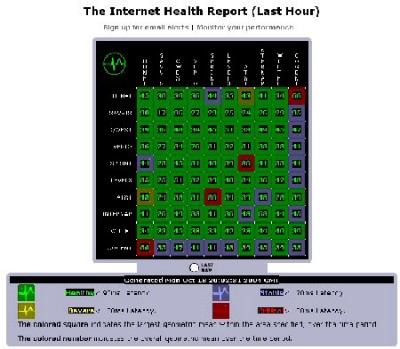
The Internet has been acting strangely today, and the Internet Health Report confirms it. The following is a screenshot from that website, taken at about 2:00 PM MDT, showing that several major Tier 1 providers are experiencing excessive latency.

Internet Health Report
No one seems to be posting anything about it yet, that I’ve seen, but there was a little buzz last week about Netsky.AG. Symantec seems more concerned about Narcs and MyDoom.AF at the moment, so it’s really tough to tell what’s happening. Fat pipes in San Francisco and New York seem to be the most affected, with latencies of over 240 ms.

It will be interesting to see what shows up on the news, if anything.

It’s a sale!

I’m pleased to announce that I am in the first stages of a non-fiction sale to a small computer magazine. The article is a short feature, and after querying the editor, I received an assignment to write the article!

This is very exciting for me. It’s an appropriate small step toward my goal of being a fiction writer. As Stephen King says in On Writing, it’s important to pay your dues before you really start to climb in the writing field. It gives you perspective and experience.

Of course, this is still in the early stages, and all kinds of things could happen. I could write the piece and the editor could decide that it doesn’t fit the magazine’s style. Or something drastic could come up and I could miss the deadline. Or something really drastic could come up that could force the editor to rethink the entire editorial schedule and my story would no longer fit. As they say, it’s not done until the work is completed, the papers are signed, the publication is in print, and the check is cashed.

But for now, there’s a sale on the horizon, and it doesn’t appear to have a skull and crossbones on it. 🙂